
Austrian Dialect: What Is Dialect? And A Little About "Bia" (Beer)
Speak like a local, drink like a local

Who wants lager, and who wants linguistics?
If strolling through the world of German grammar sounds a little too dry for these hot summer days, skip halfway down for the Austrian beer section. Otherwise, here comes the fascinating field of German dialects!
What is Dialect?
G’day, mate. Top o’ th’mornin’ to ye. Hey, howzit goin?
In English, we can recognize different styles of speaking based on location, class, and generation. In English, and any other language with speakers spread out over a large territory, these separate ways of using the language can grow so far apart, to the point where we have a hard time understanding one another. When those differences grow large enough, we call the varieties of the same language dialects.
German has drifted much further than English down the dialect path1, despite being spoken by fewer people in a smaller area. For reasons of trading partners, invasions, mountain passes, politics, and history, German has fractured into many distinct dialects over the centuries—so much so, that people from one region often cannot understand people from another at all.
Just look at this map, of Germany only, showing some of the many ways that people greet one another:
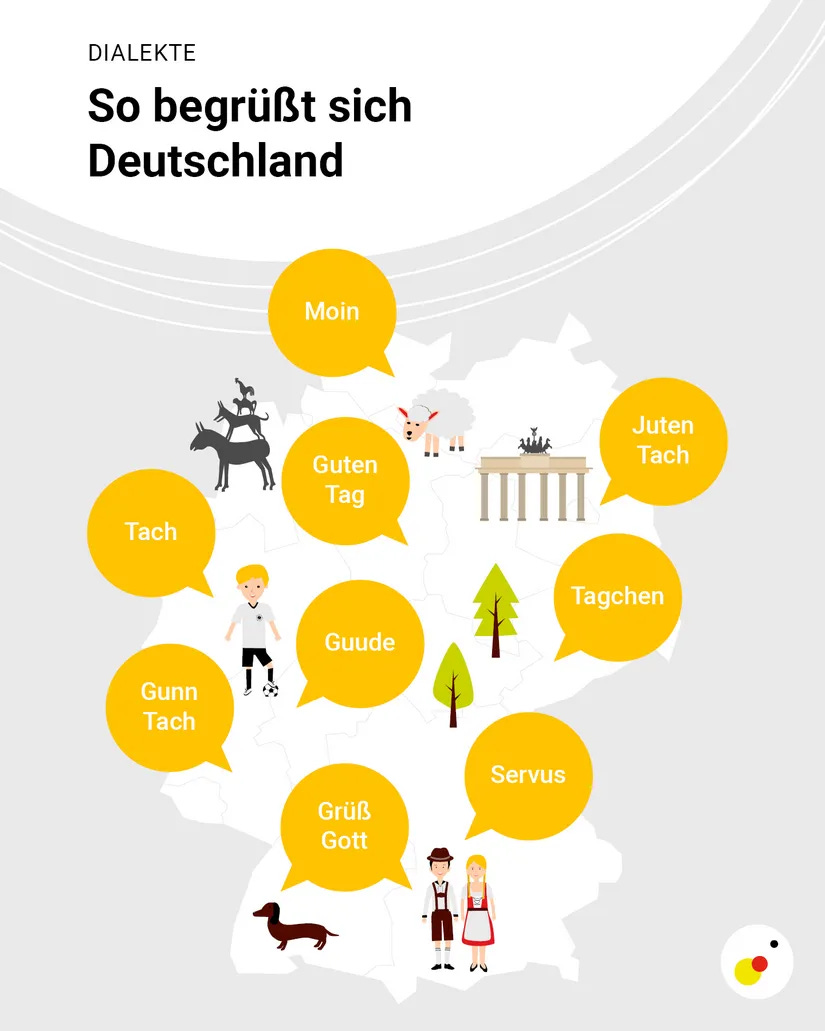
We in Austria never greet someone with guten Tag; at least, I have never once heard an Austrian say that. But this is the greeting you will learn in German class, and hear most often in Germany. We say, instead servus, siabus, grüß Gott, grüß di, or grias di.
Another example: in the far North of Germany, one says “ik heff” for “I have,” and here in Austria, one says “i hob.” You can see the similarity, but imagine most words varying to similar degrees, and being spoken rapidly—it’s a recipe for miscommunication. And here is where Standard German enters.
“Standard German” is what you learn in the classroom, and what is spoken and written in the media. This isn’t exactly a natural language, or it wasn’t—it was pieced together artificially during the Renaissance, similar to what Atatürk did with Turkish a century ago, or scholars have done to create Modern Standard Arabic. The idea of streamlining language varieties based on an artificial set of parameters caught on very strongly, especially in the Center and North of Germany, so that now most Germans speak Standard German. We don’t have an equivalent with English, but it might be something like if we all tried to talk like a TV presenter reading Shakespeare, and called that Standard English. It’d sound silly at first, but after centuries of it being forced upon us, we’d mostly be talking that way too.
Because of the challenging terrain in the Southern parts of the German-speaking zone, and the lack of broadcast media when standardization occurred, the speakers of Southern dialects in particular have retained their ways of speech until today. Most native Swiss speakers use one or another local Swiss German dialect. Same for its neighbor Liechtenstein. In Austria, the majority of people speaks dialect, but this is fading out in the big cities. In Italian South Tyrol and the other small German-speaking areas of Central Europe, dialect still predominates.
Some dialects have only a handful of speakers, and others have millions. I live in the middle of the very largest dialect, Austro-Bavarian, which has about 13 million speakers, and is called boarisch by its users. As you can guess by the name, Austro-Bavarian is predominantly spoken in Austria and Bavaria.2 I speak dialect in my everyday life, because we live in a rural area, and that is how almost everyone here talks. If I’m traveling to another German-speaking country, or I meet someone who only learned German in a classroom (such as the many recent Middle Eastern immigrants here), I will switch to Standard German. If the concept seems hazy to you, think of the following exchange I had once in Scotland (slightly modified for space and clarity):
Woman on the bus: “I cannae fit ma pop a boar.”
Me: “Pardon?”
Woman: “Ma pop. His hoos is too big. He cannae fit.”
Me: “Your pup? Your dog’s carrier won’t fit on board?”
Woman: “Aye.”
Imagine differences in vocabulary and pronunciation like this, multiplied fourfold, and that would approximate the differences in German dialects. You really have to slow down and try different words to be understood. Most Austrians I’ve asked, in fact, told me that learning Standard German at school was like studying a foreign language.
First-year linguistics students often learn the saying, “A language is a dialect with an army and a navy.” This is true. The separate German dialects are basically distinct, related languages by any objective measure (there is no universally-agreed border between a dialect and a language), but because they generally don’t have the representation of an entire country, they are not considered “real” languages. However, two have become so—Dutch and Luxembourgish are simply Germanic dialects that officially became their own full language once these nations gained independence. If Austria were to declare tomorrow that boarisch is its official language, you would then have to study Austro-Bavarian as something separate from Standard German, and visitors from Berlin and Hamburg would have to communicate with us in English because boarisch is not understandable to Northern Germans.
This is exactly a conversation I had recently with some locals in Flensburg, at the far North of Germany, over some beers. They recounted a recent vacation in Vienna where they couldn’t understand a single word that their driver said. They told me this in Standard German, because their dialect would’ve been unintelligible to me. And thus the inspiration for this article about dialect and beer. Now for the beer!

Back to Beer
Here’s the good stuff. Beer is Bier in German, and Bia in Austrian dialect. It sounds just like the guy in the old Foster’s ads.
A tip if you’re ever in Austria or Bavaria: forget textbook German like Ein großes Bier, bitte, when ordering a large beer. Here you’ll just say a hoibe—“a half,” meaning half a liter, or about a pint. For a bigger thirst, you order a Maß (sounds like “moss”), a full liter, more often seen in Bavaria, at beer-tent fundraisers, and at Oktoberfest.

What kinds of Bia do the folks drink here? Mostly lagers. The word “lager” in English comes from German Lager, meaning storage. Cold-stored beers, such as lager, fermented more slowly, which produced the crisp, clean lagers we know today. This is because if beer takes a relatively long while to ferment (weeks to months), like lager does, any slight imperfection in the taste will get multiplied over time. So brewers strive to keep lager lighter and smoother. Ales, by contrast, are brewed warmer and faster (days to weeks), and can have much stronger flavors, because the flavors do not get out of hand with the short fermentation period.
Lagers are the soft classical music you could have in the background all the time without it bothering you, while ales are like the oompah or Rammstein concert you can only take in shorter periods. Both have their roles, but it’s no surprise that bold ales lead the way in the brash, consumerist English-speaking world, while subdued lagers are prevalent here in the historic heart of Europe.
Some varieties popular here are:
Austria’s Beer Lineup
Märzen – A real chameleon, and Austria’s most common variety: amber, slightly sweet, heady, goes with anything from sausages to solo sipping.
Zwickl – Malty, unfiltered cousin of Märzen.
Helles – Light and bright, perfect with lemonade as a Radler. Don’t be startled when Hell is printed on a bottle, though. That’s one form of the word, as German words can take different endings. Best not to worry about that, though.
Pils – Hoppier, Czech-born, drinks well with a solid meal. Garlic pairings are de rigeur in Czechia.
Weißbier / Weizenbier – Thick wheat beer, banana notes, beloved with white sausages or after a sweaty workout. This is what we call a hefeweizen in English, which of course is also a German word, but they tend not to use that word3.
Dunkel – Dark, malty, sometimes sweet or smoky. Surprisingly good with dessert.
Ales – An English import gaining traction in Austrian craft breweries: IPA, Red, Pale—you name it. They simply use the same word “ale” from English.
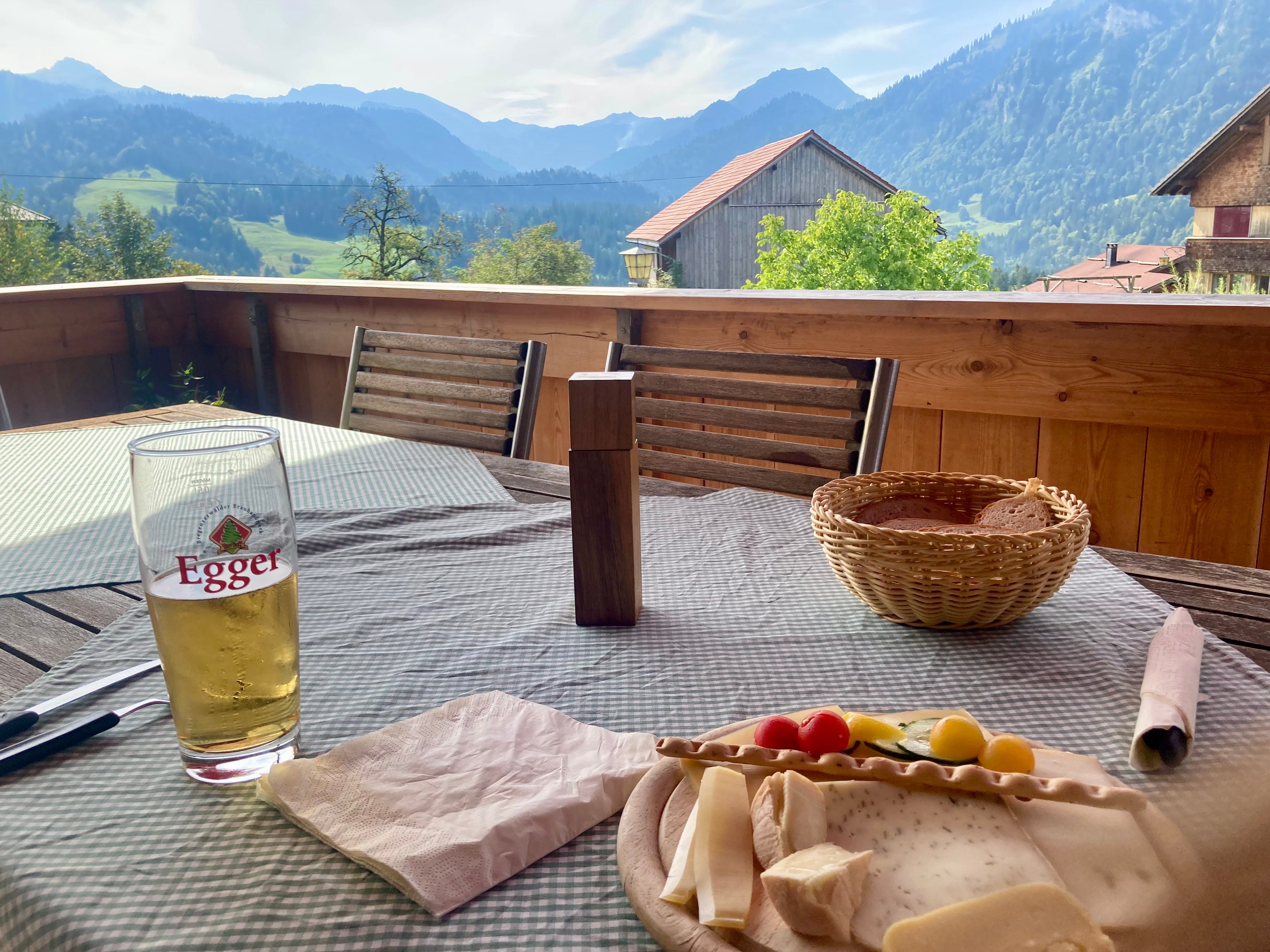
Languages shift. So does beer. I’ll reach for a Märzen, you might chase a hefeweizen or a Baltic ale. Either way, the more you talk, the thirstier you get, and the more you drink, the chattier you become. Prost! (That’s “cheers” in German, and can also be spelled prosit).
English actually used to have just as wide of a field of dialects as German does now. However, these dialects have been mostly stamped out in the 20th century by educational efforts, and the growth of radio. We are taught that saying things like “ain’t” is somehow wrong, and that therefore all of the rich varieties of English are full of “wrong” grammar and shouldn’t be used, lest you be perceived as low-class and uneducated for speaking them. But we all can recognize different dialects still in English. There is a language called Scots, which some consider a dialect, which is closer to English than the German dialects are to each other, and you know a couple lines of it: “Should auld acquaintance be forgot, and auld lang syne?” Probably when you first heard it at some New Year’s party, you didn’t know what “auld lang syne” meant (it’s something like “a long time ago”). If Scots and English had only a handful of centuries to develop apart, imagine how different the German from Apenrade, in today’s Southern Denmark, became from the German of Bozen, in today’s Italian South Tyrol, after more than a millennium apart.
Parts of Austria and Bavaria speak other, related dialects, and parts speak very distant dialects, like Schwabian and Allemanic. We from the middle of Austria can generally understand most other Austrians, but not, for example, people from the mountainous Western part of the country, unless we speak slowly and avoid local expressions. For example, a Tyrolean might refer to his capital city as something that sounds like “Eeschproch,” which is how some dialects pronounce Innsbruck.
You will sometimes see Hefeweizen or Hefe Weizen written in Germany, but not typically. Also, this style tastes like rotten cantaloupe to me, but that’s just my palette.
I am in awe of your ability to understand and speak dialect, Joshua, and to switch to Hochdeutsch when required! When I am with my husband's Austrian friends and family, the only time I understand what they are saying is when they try to speak Hochdeutsch with me. (And this, understandably, never lasts very long.) Gerhard hates to speak Hochdeutsch with me (for cultural reasons) and thinks English is much easier. So that is how we communicate.
This was super interesting Joshua